What Documents Can’t a Notary Notarize? (And Why It Matters)
If you’ve ever wondered, “Can a notary notarize anything?” — you’re not alone.
A notary’s role is to verify identity, confirm the signer is willing and aware,
and complete the correct notarial act. A notary does not approve the contents of a document or provide legal advice.
Because of that, there are certain documents and situations a Pennsylvania notary must decline.
Below are common examples of requests a notary typically cannot perform — and how to avoid delays.
Documents a Notary Typically Cannot Notarize
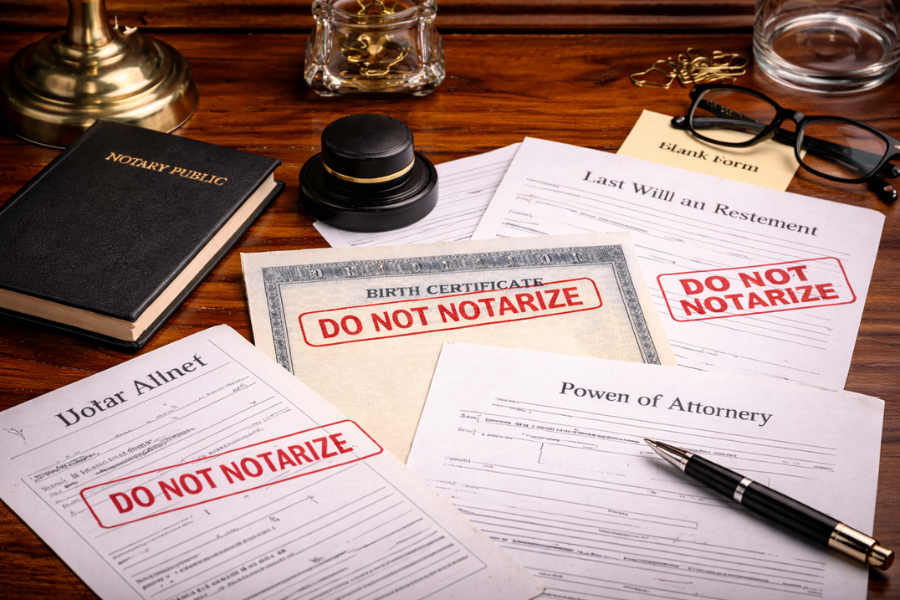
1) Vital records as “certified copies”
In most cases, notaries cannot create certified copies of vital records
like birth certificates, death certificates, or marriage certificates.
These records are usually certified only by the government agency that issued them.
What to do instead: Request a certified copy directly from the issuing office.
2) Incomplete documents
A notary may have to refuse a notarization if the document is incomplete — for example,
missing pages, large blank spaces that should be completed, or missing key information.
Notarizing an incomplete document can increase the risk of fraud or later changes.
Tip: Bring all pages and complete what you can (without signing) before your appointment.
3) Documents the signer doesn’t understand or appears forced to sign
A notary must be confident the signer is acting voluntarily and appears aware of what they’re signing.
If someone seems pressured, confused, or unable to communicate willingness, the notary may need to refuse.
Tip: If a signer needs extra time or clarification, pause and contact the document preparer or attorney.
4) Requests that involve legal advice or choosing document types
Notaries are not allowed to give legal advice unless they are also a licensed attorney.
That means a notary cannot tell you which document you should use, what boxes to check, or how to fill out legal language.
Tip: If you’re unsure what you need, contact the agency, lender,
title company, or attorney who provided the paperwork.
5) Documents with serious name or ID mismatches
A notary must be able to properly identify the signer.
If the name on the document does not reasonably match the name on the signer’s
valid government-issued photo ID, the notarization may not be possible.
Tip: Double-check the document name format (middle initials,
hyphens, suffixes) before the appointment.
Situations Where a Notary Must Refuse (Even If the Document Looks Fine)
1) The signer is not present
A notary cannot notarize a signature for someone who is not physically present
(or present via an authorized remote process, when applicable).
If the signer is not there, the notarization cannot happen.
2) The signer cannot be properly identified
If the signer does not have acceptable identification and the notary cannot verify
identity using methods allowed by law, the notary must decline.
3) The notary is asked to backdate, alter facts, or notarize improperly
A notary must refuse requests to do anything improper, such as:
- Notarizing without the signer present
- Backdating a notarization
- Changing notary wording after the fact to “make it work”
- Notarizing something the notary knows is dishonest or unlawful
How to Avoid Delays at Your Notary Appointment
Use this quick checklist before your appointment:
- Bring a valid government-issued photo ID
- Bring the complete document (all pages included)
- Do not sign ahead of time unless you are told it is allowed
- Make sure all signers are present
- Confirm whether witnesses are required
Need a Mobile Notary in Pittsburgh?
If you’re in Pittsburgh or the surrounding areas and have questions about whether your document can be notarized or what is required, Signings by Marion provides mobile notary services that come to you — including homes, offices, hospitals, and nursing facilities (when permitted).